July 10, 2026
Melissa is a mother and a nurse. Her life was full, busy and centered around caring for others. On July 1, 2023, that changed in an instant.
While leaving a Target store with her mother and youngest daughter, Melissa was loading items into her minivan when a vehicle suddenly reversed across the aisle and pinned her between the two cars. The driver, unaware the car was in reverse, crushed Melissa with significant force.
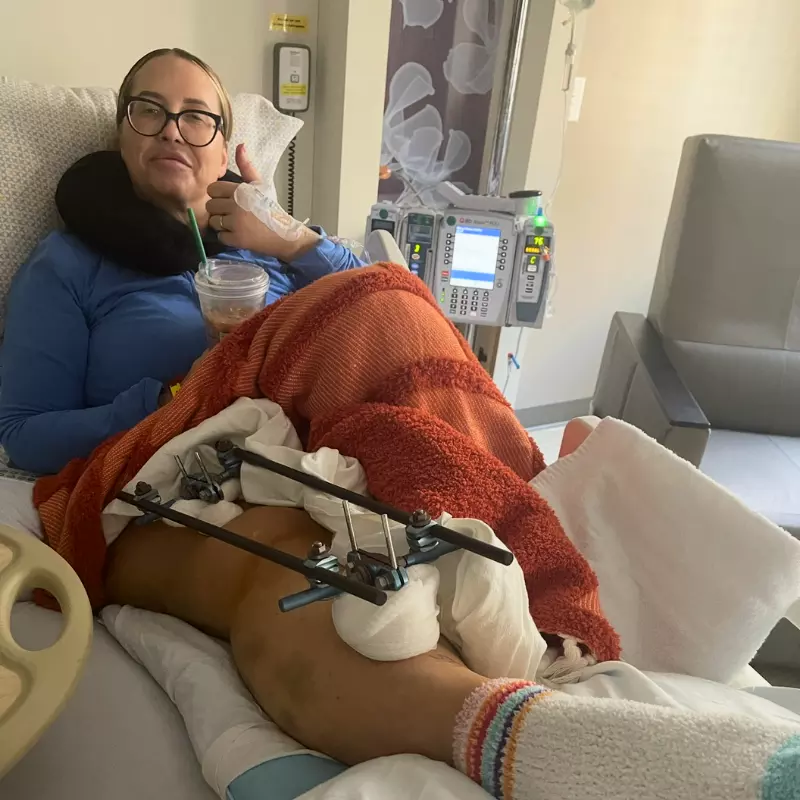 An external fixator was used to stabilize Melissa's leg.
Fighting to Save Her Life and Her Leg
Melissa was transported to a local trauma center, where the immediate focus was saving her life, followed by the question of whether her leg could be saved.
The injuries were severe. Her tibial plateau – the weight-bearing surface of the knee – was completely shattered. At the same time, the trauma crushed her peroneal nerve, a major nerve responsible for lifting and controlling the foot.
She spent two weeks in the hospital undergoing urgent procedures to stabilize her injuries. Her leg was saved, but paralysis remained. She was repeatedly told that nerve recovery might come with time. The injury left Melissa unable to lift her foot or ankle and without sensation across the top of her foot. As the weeks passed, however, Melissa became increasingly uneasy with a wait-and-see approach.
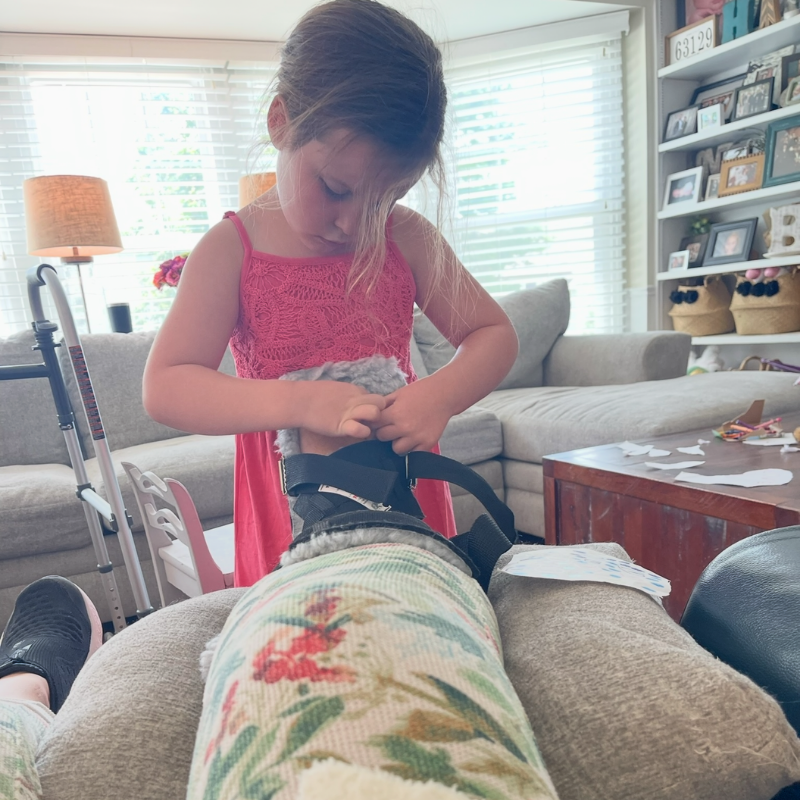 Melissa had to accept the help of even the youngest caregivers.
Her Continued Struggle
Returning home brought a different kind of challenge. Melissa went from being an independent, working nurse and active mother to relying entirely on others for daily care. She could not walk, navigate her home, or care for herself without assistance.
The physical loss was profound, but so was the emotional weight – missing her daughter’s first day of kindergarten and watching life continue while she remained sidelined. Still, Melissa held onto something steady: her clinical mindset. She began researching her injury with the same determination she had brought to her nursing career.
A Story That Changed Everything
During long, sleepless nights, Melissa searched for answers. She read everything she could about tibial plateau fractures and peroneal nerve injuries, searching for examples of recovery. What she found instead was discouraging. Cases as severe as hers rarely improved without intervention.
She came across the story of Ashley Judd, who had publicly shared her recovery from a devastating leg injury that included nerve damage and paralysis. Judd described regaining function after receiving specialized nerve care.
“I remember reading about her doing the alphabet with her foot,” Melissa recalled. “At that point, I couldn’t even move a toe.”
The story offered more than hope – it offered direction.
Following the path outlined in Judd’s recovery story ultimately led Melissa to WashU Medicine Orthopedics and peripheral nerve surgeon Christopher Dy, MD, MPH.
That timing proved critical.
“Nerve injuries are time sensitive,” Dr. Dy said. “If specialized evaluation is unnecessarily delayed, there may be missed opportunities to restore innervation to the affected muscles through procedures like nerve grafting and nerve transfers.”
Finding the Right Team
Advanced testing, including ultrasound imaging and electrodiagnostic studies performed by WashU Medicine specialist Nathan Olafsen, MD, confirmed the severity of the injury. The studies also revealed something important: not all portions of the damaged nerve had been affected equally.
Based on the testing and Melissa’s clinical examination, Dr. Dy determined that the portion of the nerve responsible for lifting the foot had sustained more severe damage, while another branch responsible for moving the foot outward remained partially functional. This was the cause of Melissa’s foot drop – “The loss of ankle dorsiflexion is commonly referred to as foot drop,” said Dr. Dy. “Having a foot drop can dramatically affect a person’s ability to walk and perform essential activities.”
An Innovative Approach
The findings created an opportunity. Melissa underwent another surgery four months after her injury.
During the procedure, Dr. Dy explored and decompressed the damaged nerve while carefully evaluating its remaining function. The findings allowed him to perform a specialized nerve transfer designed to accelerate recovery of ankle movement.
“We determined that we could perform a specific type of nerve transfer that would drastically speed up her recovery of ankle dorsiflexion,” Dr. Dy said.
The approach was particularly meaningful because it reflected decades of innovation in peripheral nerve surgery at WashU Medicine. Dr. Dy and his colleagues were the first to describe this specific combination of nerve transfers, later publishing their findings to help advance treatment for future patients.
For Melissa, it represented something she desperately wanted: a chance.
A Patient Recovery
What followed required extraordinary patience. For months after surgery, Melissa saw no visible improvement. It was difficult to believe progress was happening. But beneath the surface, healing was finally underway.
“The nerves are regenerating across the area where they were sutured together during the nerve transfer and slowly making their way to the muscles,” Dr. Dy explained. “Once that connection is restored, the nerve-to-muscle connection needs to mature, and the muscle needs to regain strength.”
Then, about four months after surgery, Melissa noticed a small flicker of movement in her toe. It was a tiny motion, but it represented months of healing and the first sign that the nerve was reconnecting with the muscles it once controlled. With time, persistence and extensive physical therapy, that flicker grew into meaningful function.
A Collaborative Effort
Melissa’s recovery required more than nerve reconstruction alone. As she recovered, lingering pain and arthritis from the injury created additional challenges.
“We know that after the type of fracture Melissa sustained – a bicondylar tibial plateau fracture – the odds of developing arthritis are quite high, even if the bone heals well,” Dr. Dy said.
To address her ongoing pain, Melissa was referred to orthopedic surgeon Ryan Nunley, MD. Before a knee replacement could be performed, however, the plates and screws used to reconstruct her fractured tibia had to be removed.
Dr. Nunley coordinated her care with orthopedic trauma surgeon Marschall Berkes, MD, who removed the hardware and prepared the leg for the next phase of treatment, and Dr. Dy, who was now an expert on the nerves in her leg. Months later, Dr. Nunley performed a total knee replacement. For Melissa, the collaboration between specialists was just as remarkable as the procedures themselves.
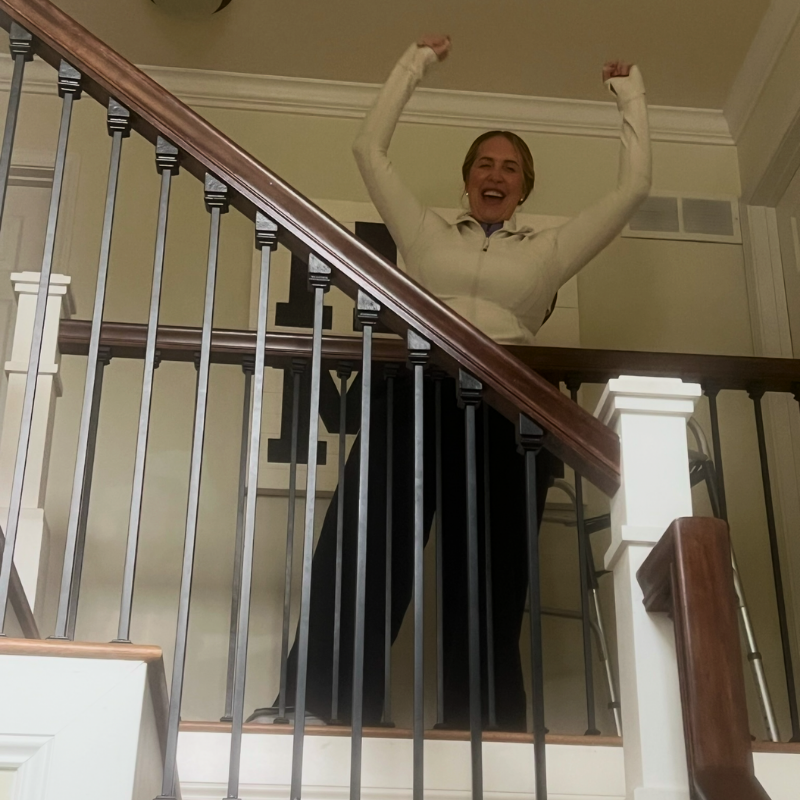 Climbing stairs independently is cause for celebration.
Step by Step
Today, Melissa has regained meaningful function in her leg. She can walk without a brace for most daily activities and has returned to work as a recovery room nurse.
She still experiences nerve pain and knows some limitations will remain. But she can walk with her daughters, attend important family milestones and participate in everyday activities that once seemed impossible.
Most importantly, she has regained her independence.

Sharing Hope
As a nurse, Melissa understands the importance of sharing knowledge. Her case has since contributed to clinical research that may help guide future treatment of similar injuries.
She hopes her story reaches someone searching for answers the way she once was. Dr. Dy shares that goal.
“I wish more patients and clinicians knew that nerve injuries of this nature are time sensitive and that we would prefer to see patients sooner rather than later,” he said. “We have many more procedures and options that we can offer patients than we did in the past. While not everyone will be a surgical candidate, there are many surgeries that can be life-changing and improve quality of life.”
For Melissa, the lesson is simple: don’t stop looking for answers. What began as a late-night search inspired by another patient’s story ultimately changed the course of her own. Now, she hopes her story can do the same for someone else.
Learn why patients choose WashU Medicine Orthopedics, request an appointment online or call (314) 514-3500.