April 22, 2026
AI Generated Turkish Translation
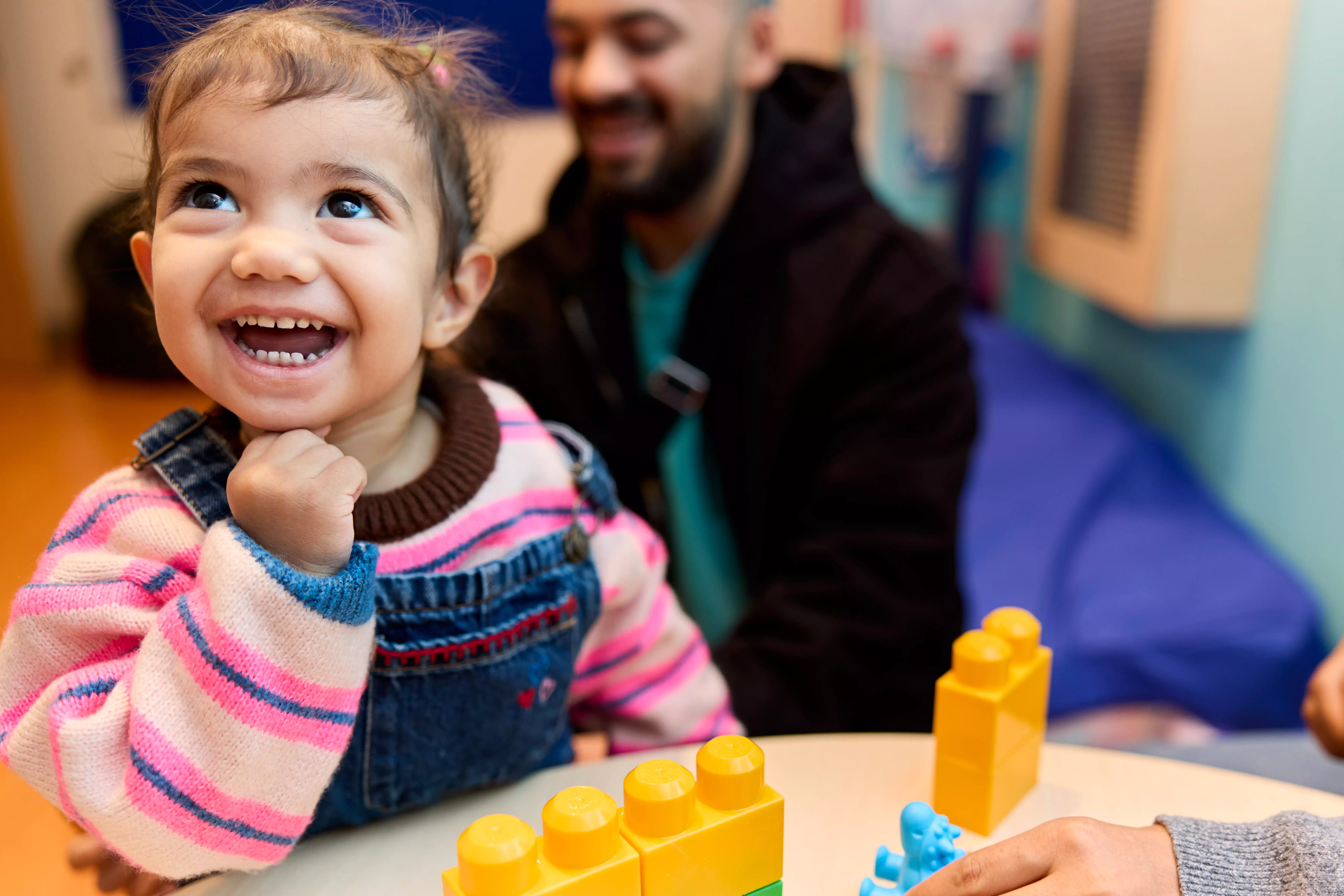 Elisa playing and father, Emircan, in background
Elisa is a curious, courageous, and extraordinary toddler. She’s one-of-a-kind and brings endless smiles and laughter to those around her. Elisa is adored and deeply loved by her family, and well-supported by their Turkish community. Like most parents, when Elisa was born, her mom and dad thought she was exceptionally special, not knowing just how true that was.
An Ultra-Rare Condition
At the time of her birth, Elisa’s parents, Emircan and Gülten, immediately noticed a difference in her left hand – she had eight fingers. The extra digits hadn’t shown up on any ultrasounds and uncertainty quickly set in. They wondered if the hand was strictly an orthopedic condition, or if it was part of something that affected her health otherwise.
At just three days old, Elisa had her first orthopedic doctor’s appointment. An X-ray revealed Elisa’s forearm was missing a radius bone, and instead she had two ulna bones – causing the extra fingers and no thumb. The doctor had never seen a case like that and was not sure what it was – so began an incredible research effort by Elisa’s family and their friends.
A hand surgeon in Türkiye diagnosed Elisa with mirror hand syndrome (ulnar dimelia) – he explained how rare this condition was and that a surgeon might encounter a case once in their career, if ever. “As a parent, you want to do everything for your child,” Emircan said. “Research showed how rare the condition is and finding the right person to care for Elisa became the most important thing.”
Finding the Best Care
Like any young family, Emircan and Gülten cherished everyday moments with their daughter, focusing on letting Elisa be a kid while also helping Elisa use her hand. After she went to sleep at night, Emircan and Gülten would spend hours researching, reading case studies, and connecting with physicians around the world to understand how to best help Elisa.
Emircan and Gülten met with surgeons from Türkiye and Germany who had both done a mirror hand surgery once, decades ago. They kept searching, “We didn’t want to look back and say, ‘I wish we had done something differently,’” Gülten explained. That search led them to Charles Goldfarb, MD, MBA. Known internationally for his expertise with congenital hand differences, Dr. Goldfarb has treated more mirror hand cases than most surgeons ever encounter. After the family learned of his success, they had conversations with Dr. Goldfarb over video calls and emails learning as much as possible about Elisa’s potential care.
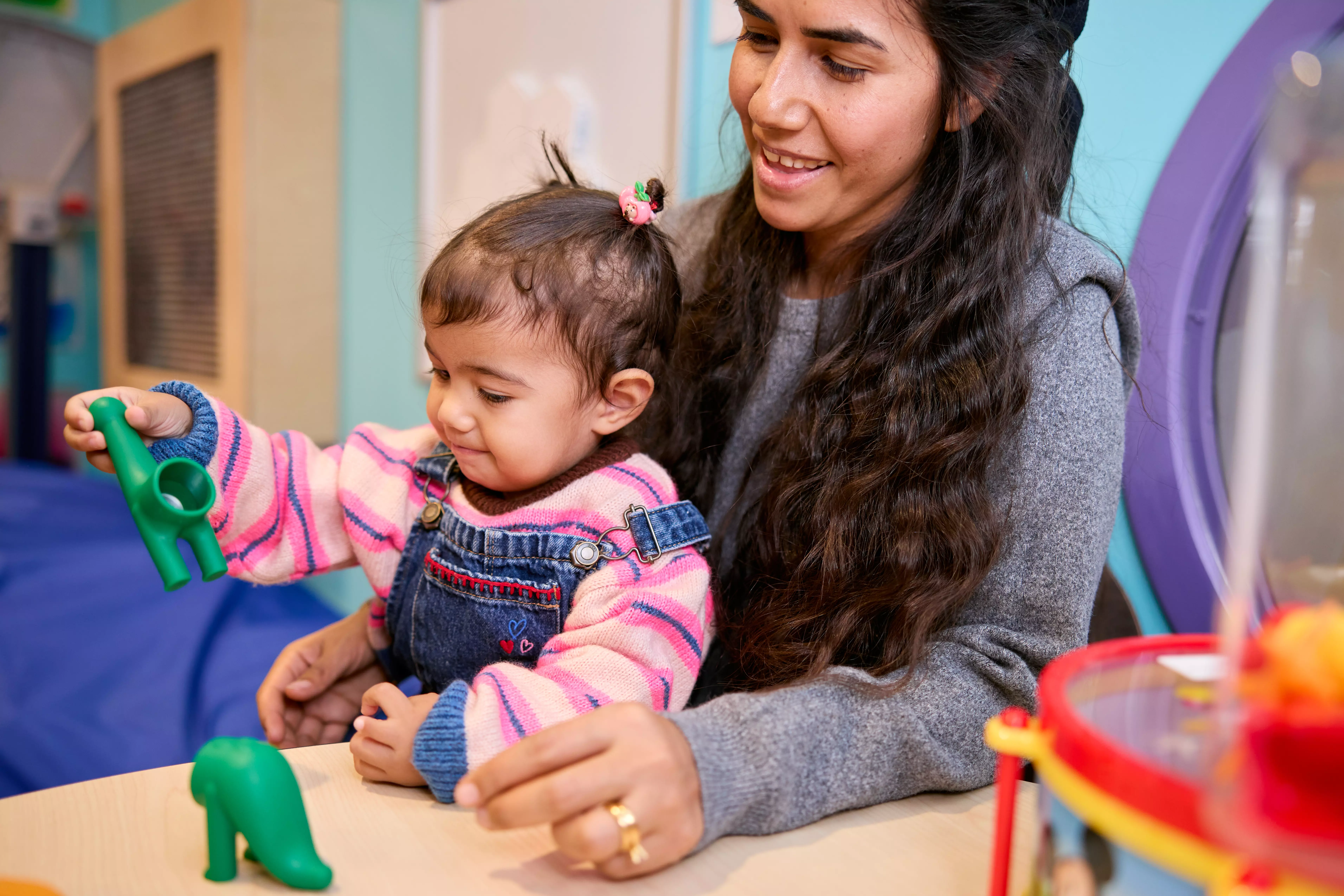
Elisa and mother, Gülten, playing at St. Louis Children's Hospital
Even though the condition is so rare, Elisa was Dr. Goldfarb’s ninth mirror hand patient, and that level of experience was important to her parents. “Most importantly we felt like Dr. Goldfarb was the right surgeon for Elisa because of his experience – when you consider the statistics it almost seems impossible.”
Making Life-Changing Care Possible
Dr. Goldfarb, WashU Medicine Orthopedics and St. Louis Children’s Hospital made the impossible, possible. The St. Louis Children’s Hospital Foundation helps children receive world-class medical care only St. Louis Children’s Hospital can provide – children like Elisa. Dr. Goldfarb told the family about assistance through the St. Louis Children’s Hospital foundation on February 21 – Emircan’s birthday. “It was the best birthday gift I’ve ever received.” With the help of the foundation, the family made the 5,700-mile journey from Türkiye to St. Louis when Elisa was the right age for surgery. The Ronald McDonald House welcomed the family, providing comfort and a home away from home.
From Eight Fingers to Five
The day of surgery is nerve-racking for all parents. Even with 18 months of planning, surgery day brings an emotional mix of hope and uncertainty. The night before, Emircan and Gülten barely slept in anticipation for the day they had been thinking about since Elisa was born. “We trusted Dr. Goldfarb and his team and deep down we were at peace,” although it was emotional to send Elisa off into surgery.
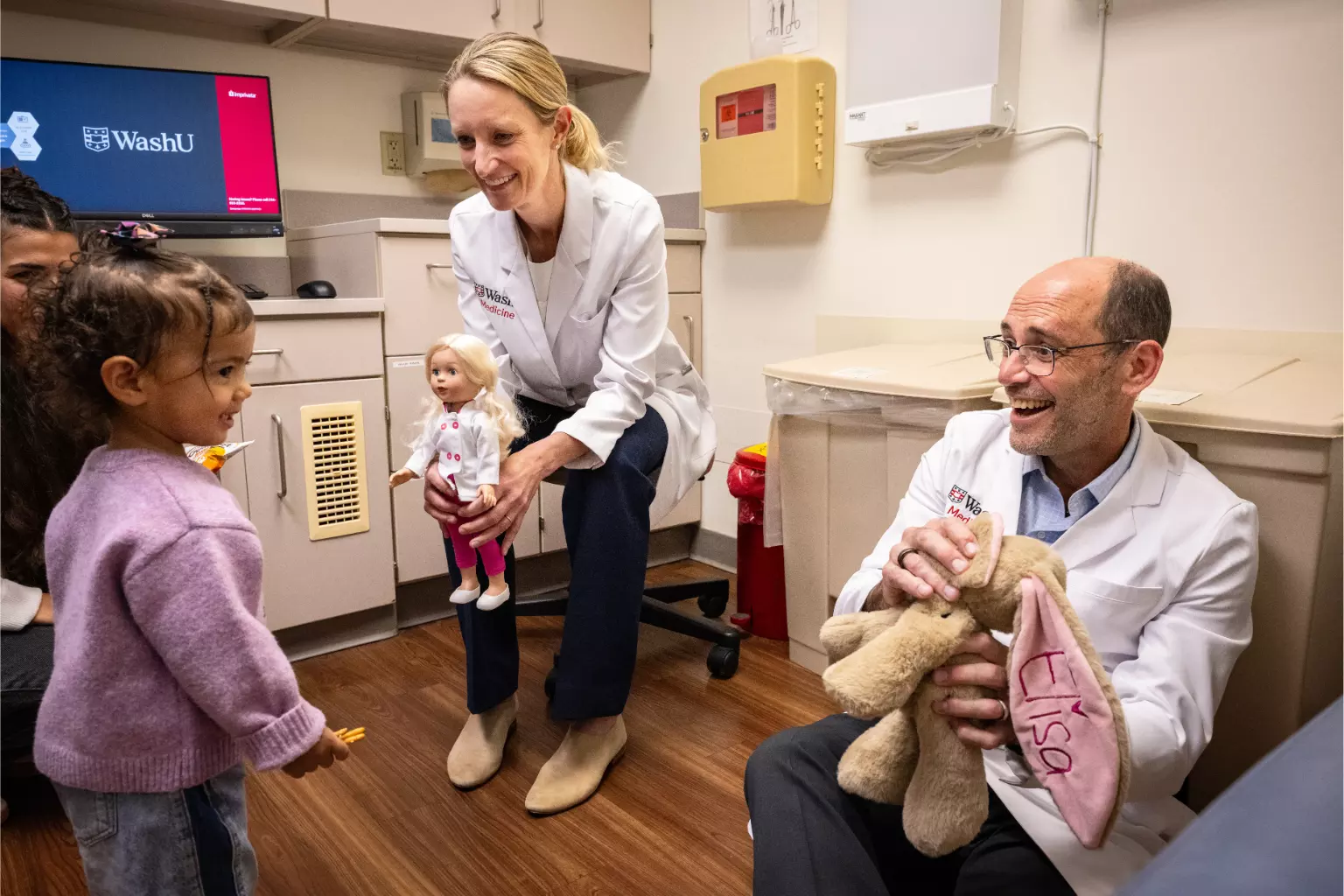 Elisa, Dr. Wall, and Dr. Goldfarb playing in clinic
Dr. Goldfarb has guiding principles for caring for mirror hand syndrome, focusing on function, alignment, and long-term adaptability. Joined by Lindley Wall, MD, MSc, the pair created a more functional hand for Elisa – one that would allow her to grasp and explore her world easier. In Elisa’s case, the focus was on improving both hand and wrist alignment. “After carefully evaluating her anatomy and observing how her fingers moved, we preserved four of her fingers and created a new thumb from a fifth,” Dr. Goldfarb explained. The thumb was created through a procedure called pollicization – an advanced reconstructive technique in children born without a functional thumb. “The three remaining fingers were removed and available tendons were transferred to help strengthen and straighten the wrist.”
Adapting to the New Hand
While healing from surgery, Elisa didn’t want anyone to touch her hand, but over the course of a couple of weeks she became more comfortable and curious. It was through the incredible work of hand therapist, Hannah Gift, that Elisa started reaching for toys and holding them with her left hand.
“In the beginning we were very careful making sure nothing happened to Elisa’s hand, but seeing her start to use it was beautiful,” her parents explained. “Elisa is very aware of the difference in her hand and when she moves her fingers, she gets very excited.” Once again, Elisa proved just how adaptable she could be. While she used to be able to hold more toys with more fingers, her hand movements have improved, and she is using her fingers in a more controlled way.
More Than Medical Care
As Elisa adjusted to using her hand in a new way, the family was also adjusting to their temporary community. Dr. Goldfarb would visit them at Ronald McDonald House and check in on Elisa outside of regular clinic follow up appointments. “We never felt like we were just patients. With Dr. Goldfarb and the whole team, we felt like part of a family,” Emircan and Gülten explained. “It didn’t feel like we were going to a hospital, but like we were going to visit people we know. Elisa has a very strong connection with the team; she truly loves them.” Her Turkish nickname for Dr. Goldfarb affectionally translates to ‘grandpa.’
.jpg)
Dr. Goldarb, Emircan, and Elisa in clinic
“We realized that even though the language might be different, once you truly want to communicate, you will always find a way,” Emircan and Gülten shared. Through interpretive services at the hospital and translation tools outside of it, the family got to know the team, and the team was delighted to get to know their family.
A Limitless Future
“In some ways, we will miss Elisa’s old hand because it was the start of this process which was so much more than just medical care,” her parents shared. They no longer worry about the psychological and functional impact of having a hand with eight fingers or how Elisa’s peers may have treated her because of it.
Although it is rare, they want other families who experience mirror hand syndrome to know they are not alone. “Things will feel uncertain at the beginning, but overtime you realize your child is so much stronger than you think. They find their way. Most importantly, don’t give up and never lose hope,” Emircan and Gülten shared. They also encourage other parents to be patient and take notice of even small changes, because those small steps are the beginning of something so much bigger – a future without limits. Their commitment to finding the best care and their determination to give their daughter every opportunity possible has set Elisa up for tremendous success.
Learn why patients choose WashU Medicine Orthopedics, request an appointment online or call (314) 514-3500.