Rotator cuff tears: symptoms, diagnosis and treatment
A rotator cuff tear happens when one or more of the tendons that help move and stabilize your shoulder become damaged or torn. Tears can develop gradually with age or happen suddenly after an injury, causing shoulder pain, weakness and difficulty moving your arm. Treatment may include physical therapy, medications or surgery, depending on the type of tear and your symptoms.
What is the rotator cuff?
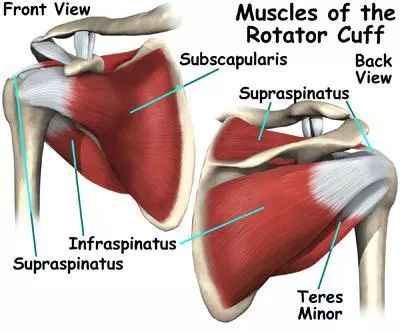
The rotator cuff is a group of four muscles that surround the shoulder joint. These muscles begin at the shoulder blade, and their tendons attach to the upper arm bone. Three of the muscles are located on the top and back of the shoulder, and one is on the front, creating a “cuff” or hood that surrounds the joint. Together, the rotator cuff helps to keep your shoulder stable and gives you the strength to lift and rotate your arm.
What is a rotator cuff tear?
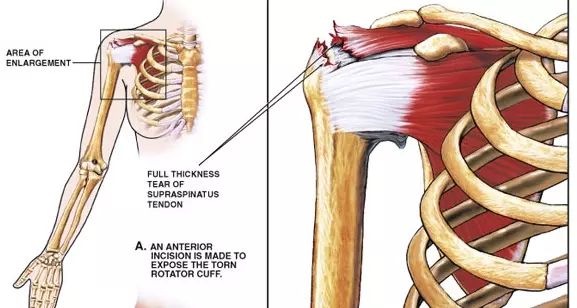
A rotator cuff tear happens when one or more of the rotator cuff tendons become damaged or separate from the bone. Rotator cuff tears are the most common shoulder injury, affecting 20% to 40% of the population.
There are two main types of rotator cuff tears:
- Partial-thickness tear: Part of the tendon is torn, but some of the tendon remains attached.
- Full-thickness tear: The tendon is completely torn through, which may allow it to pull away from the bone.
What causes a rotator cuff tear?
Many rotator cuff tears develop gradually as the tendon changes with age. A tear can also happen suddenly because of an injury. Factors that can contribute to a rotator cuff tear include:
- Age-related changes
- Injury to the rotator cuff
- Bone spurs
- Tobacco use
What are the symptoms of a rotator cuff tear?
Rotator cuff tear symptoms can vary depending on the type and size of the tear. A sudden tear caused by an injury may cause immediate pain and weakness. Tears that develop over time may cause symptoms that gradually become worse.
Common rotator cuff tear symptoms may include:
- Pain in the shoulder, especially when lifting or reaching
- Pain that gets worse at night or when lying on the affected shoulder
- Weakness when lifting or rotating the arm
- Difficulty reaching overhead or behind your back
- A popping or crackling feeling with certain shoulder movements
How is a rotator cuff tear diagnosed?
To diagnose a rotator cuff tear, your doctor will ask about your symptoms, when they started and whether you injured your shoulder. They will also examine your shoulder to see how well you can move your arm and check for pain or weakness.
Your doctor may also use imaging to get a closer look at your shoulder:
- X-rays can show bone spurs, arthritis or other problems that may be causing shoulder pain. Rotator cuff tears do not show up on X-rays.
- Ultrasound uses sound waves to create images of the tendons and other soft tissues in your shoulder.
- MRI provides detailed images that can help your doctor find a rotator cuff tear and learn more about its size and location.
Your doctor will consider your symptoms, exam and imaging results together to determine what is causing your shoulder pain and recommend the right treatment.
Learn about common symptoms of rotator cuff tears, how they are diagnosed and available treatment options in this video with WashU Medicine orthopedic shoulder specialists:
How are rotator cuff tears treated?
Nonsurgical treatment for rotator cuff tears
Not all rotator cuff tears need surgery. Nonsurgical treatment focuses on reducing pain, improving shoulder movement and building strength so you can return to your normal activities.
Treatment may include:
- Activity changes and rest to avoid movements that make your shoulder pain worse.
- Physical therapy to improve shoulder movement, flexibility and strength.
- Pain or anti-inflammatory medicine to help reduce pain and swelling.
- Steroid injections can provide temporary pain relief and make it easier to sleep, complete daily activities or participate in physical therapy.
Your doctor will consider the type and size of your tear, your symptoms, activity level and overall health when deciding which treatments may be right for you.
Surgery for rotator cuff tears
Surgery may be recommended when shoulder pain or weakness continues despite nonsurgical treatment. It may also be considered for larger or complete tears, tears caused by a sudden injury, or when weakness makes it difficult to use your arm for everyday activities, work or sports.
The goal of rotator cuff surgery is to reduce pain and improve shoulder function. During a rotator cuff repair, the surgeon reattaches the torn tendon to the upper arm bone. In most cases, this can be done with arthroscopic surgery, using a small camera and surgical tools placed through small incisions.
Some large or complex tears may require a different surgical approach. The type of surgery recommended depends on the size and location of the tear, the condition of the tendon and other problems in the shoulder. Large rotator cuff tears or tears that have been present for a long time may not always be fully repairable. Sometimes, your surgeon can’t determine whether a tear can be repaired until surgery. If a complete repair is not possible, other treatment options may be considered based on the condition of the tendon, your shoulder function and your individual needs.
Can a rotator cuff tear heal without surgery?
A rotator cuff tendon that has completely torn away from the bone does not typically reattach to the bone on its own. However, not every rotator cuff tear requires surgery. Many people can improve pain and shoulder function with nonsurgical treatments such as activity changes, physical therapy, medications or injections.
What happens during rotator cuff surgery?
Rotator cuff repair involves reattaching the torn tendon to the bone. In most cases, the procedure can be performed arthroscopically through several small incisions. A small camera allows the surgeon to examine the shoulder and locate the tear.
Small anchors containing sutures are placed into the bone, and the sutures are used to secure the tendon back to its attachment. The number of anchors needed depends on the size of the tear. Some larger or more complex tears may require a larger incision.
As part of the procedure, your surgeon may also perform a subacromial decompression. This involves removing inflamed tissue from the space above the rotator cuff. If bone spurs are present, they may also be smoothed to create more space around the tendon.
Are other procedures sometimes performed at the same time as rotator cuff surgery?
During surgery, your surgeon examines other structures in the shoulder that may also be causing pain. Depending on your condition, additional treatment may be needed for the biceps tendon or the acromioclavicular (AC) joint.
Biceps tenotomy or tenodesis
Surgery for the biceps tendon is needed in about 25% of patients with a rotator cuff tear. A biceps tendon procedure is only performed if there is a problem with the biceps tendon that could continue to cause shoulder pain after rotator cuff surgery. Sometimes, damage to the biceps tendon is not seen until the time of surgery because it may not always be visible on an MRI or ultrasound.
Surgery may involve removing the damaged biceps tendon from inside the shoulder joint and reattaching it where it exits the joint. This is called biceps tenodesis. In some cases, the surgeon may simply release the tendon and allow it to move away from the joint. This is called a biceps tenotomy.
Releasing the tendon may cause the biceps muscle to look different from one side to the other (asymmetry). Some patients may also experience muscle spasms, which usually improve over time. These changes rarely cause problems and do not affect shoulder function. The biceps muscle will continue to work at the elbow, and releasing or moving this tendon does not affect shoulder motion or strength.
Sometimes a biceps tenodesis can be performed arthroscopically through small incisions. In younger or more active patients, an open biceps tenodesis surgery may be recommended. Your surgeon will discuss which approach may be best for you before surgery.
Distal clavicle resection
A distal clavicle resection may be performed if you have pain at the acromioclavicular (AC) joint, where the collarbone meets the shoulder. The decision to perform this procedure is based on symptoms. Many patients have changes in the AC joint that can be seen on an X-ray or MRI.
If the joint is not painful, surgery is usually not needed, even if an X-ray or MRI shows changes in the joint. If the joint is painful, the surgeon removes damaged tissue and a small amount of bone (about 5 to 7 millimeters) from the end of the collarbone. The ligaments are left in place to keep the joint stable.
A distal clavicle resection does not cause a loss of shoulder function and does not lengthen the recovery period after rotator cuff surgery.
What is recovery like after rotator cuff surgery?
Recovery after rotator cuff surgery takes several months because the tendon needs time to heal back to the bone. Most patients wear a sling for several weeks and slowly begin shoulder movement and strengthening as they heal.
The timing of physical therapy and return to work, driving, exercise and sports depends on the size of your tear, the type of repair and how well your shoulder is healing. Your surgeon will guide you through each stage of recovery.
Tobacco use can impair healing after rotator cuff surgery, and in some cases, may have contributed to the original tear.
What are the risks of surgery?
Possible risks of rotator cuff repair include infection, stiffness, bleeding, nerve or blood vessel injury, blood clots, failure of the tendon to fully heal to the bone, problems with the anchors or sutures, and continued symptoms after surgery. Your surgeon will discuss your individual risks and expected outcomes before surgery.
What results can I expect after rotator cuff repair?
The goal of rotator cuff repair is to reduce pain and improve shoulder function. Recovery and healing can vary based on factors such as the size of the tear, age and tendon quality.
Smaller rotator cuff tears that are repaired earlier tend to heal better than larger tears or tears that have been present for a long time. Age can also affect healing. Patients younger than 65 are more likely to have the tendon fully heal after surgery. In older patients, surgery can still reduce pain and improve shoulder function, although some weakness may remain.
Generally, about 90% of patients are satisfied with their shoulders after rotator cuff repair and have significant improvements in pain and function after surgery.
Why choose WashU Medicine Orthopedics for rotator cuff care?
WashU Medicine orthopedic specialists provide expert care for shoulder conditions, from common injuries to complex problems. Our team includes orthopedic surgeons with advanced fellowship training in shoulder care, offering both nonsurgical and surgical treatment options.
As part of an academic medical center, our physicians combine patient care with research and education to help advance how shoulder conditions are treated. When surgery is needed, our surgeons use advanced techniques, including minimally invasive arthroscopic procedures, to repair the shoulder and help patients return to the activities that matter to them.
Rotator cuff tears FAQs
How common are age-related rotator cuff tears?
By age of 60, approximately 30% of people will have a rotator cuff tear that may or may not cause pain, and over 50% of people will have some abnormality of the rotator cuff.
Can a rotator cuff tear get worse over time if left untreated?
Yes, some rotator cuff tears can become larger over time, especially as the tendon continues to weaken with age or use. A larger tear may cause more weakness and can be more difficult to repair. About 30% of large rotator cuff tears left untreated may develop rotator cuff arthropathy, a type of shoulder arthritis that can lead to increased pain and loss of function.
However, not every rotator cuff tear gets worse or requires surgery. Treatment depends on your symptoms, the size of the tear, your activity level and other factors.
How long will I wear a sling after rotator cuff surgery?
Most patients wear a sling for 4 to 6 weeks after surgery to protect the repaired tendon while it heals. Your surgeon will tell you when it's safe t o stop wearing your sling. Learn more about caring for your shoulder after surgery.
When can I drive after rotator cuff surgery?
If you had a rotator cuff repair, wait until at least your first follow-up visit before driving. You should be able to safely control your vehicle and should never drive while taking narcotic pain medication. Learn more about driving after rotator cuff surgery.
When can I return to work or sports after rotator cuff surgery?
Your return to work or sports depends on your recovery and the physical demands of your activities. Light-duty work may be possible sooner, while heavy lifting, overhead work and sports may require several months of healing. Return to vigorous sports may take six months or longer. Learn more about recovery after rotator cuff surgery.
Can a rotator cuff tear come back after surgery?
Yes. A rotator cuff tendon can tear again or may not fully heal after surgery. The risk is higher with larger tears and can also be affected by factors such as age and the health of the tendon. Following your surgeon's recovery plan and allowing the tendon enough time to heal before returning to strenuous activities can help protect the repair.
When should I see an orthopedic specialist for shoulder pain?
See a shoulder specialist if your pain does not improve, gets worse or makes it hard to use your arm. You should also seek care if you have ongoing shoulder weakness or pain after an injury. A shoulder specialist can determine what is causing your symptoms and recommend the right treatment.